Abstract
This report uses principal component analysis (PCA) and diffusion mapping to examine the hypothesis that Ḥafṣ ʿan ʿĀṣim preserves a widely shared, majority recitation of early Islam. Comparing twenty transmissions of the ten canonical readers reveals broad regional groupings, with Ḥafṣ occupying a distinct, comparatively central position between them. The report proposes that recurring contact and communal prayer at Hajj helped preserve this comparatively central form across regions, and that Hadith al-Thaqalayn at Ghadīr Khumm supplied a basis for recognising ʿAlī’s Qurʾānic authority, to which Ḥafṣ’s transmission is traditionally traced.
1. Purpose and computational approach
This report compares twenty transmissions of the ten canonical Qurʾānic readers using principal component analysis (PCA) and diffusion mapping. PCA summarises the main contrasts and provides a comparison with Hythem Sidky’s study of consonantal dotting. Diffusion mapping then examines relationships across the full set, with particular attention to regional groupings and the transmissions of ʿĀṣim.
Computational attribution. GPT-6 Astra assisted with organising the recorded variants, developing and running Python calculations, checking numerical results, and producing the tables, graphs and interactive map. All reported calculations and visualisations use the archived dataset and methods described below. The historical interpretations are the author’s arguments.
2. Sources and comparison rules
The study uses the archived nQuran Shāṭibiyyah/Durrah inventory, covering all 114 surahs and dated 20 September 2026. It compares twenty transmissions, two for each canonical reader. Of 33,602 source records, 29,349 were coded and 4,253 excluded, producing 33,305 comparison features. A record can describe several features, such as vowel quality and length. Unresolved readings were not supplied from Ḥafṣ or another reference transmission. 1
PCA uses 15,214 fixed features across 620 blocks. “Fixed” means that each transmission permits exactly one form at the feature being compared; the transmissions need not agree. One may specify fatḥah and another kasrah. If any transmission permits both, the feature is excluded from the PCA rather than reduced to a selected alternative.
Diffusion mapping uses 33,305 features across 625 blocks, retaining multiple explicitly permitted forms within a single transmission where they occur. Similarities between these sets form a network, and the map represents each transmission’s connections across it. Permitted alternatives apply to individual features; they do not establish that every combination belongs to a valid recitation route.
| Analysis | Included features | Equally weighted blocks | Treatment of alternatives |
|---|---|---|---|
| PCA | 15,214 fixed features | 620 | One permitted form per transmission |
| Diffusion mapping | 33,305 features | 625 | Sets of permitted forms retained |
Table 1. Comparison datasets and treatment of permitted forms. Inventory counts and tabulation: GPT-6 Astra.
Both analyses give each block equal total weight. Blocks group recurring pronunciation rules or related word forms. A rule occurring at 100 positions shares one block’s weight across those positions, limiting the influence of repetition. This reduces repeated counting without guaranteeing that every block is independent. In the diffusion analysis, 583 of 625 blocks concern fixed word variants, accounting for approximately 93.3% of the total weight. The results therefore mainly reflect word-level variation and depend partly on the grouping of features.
3. Principal component analysis
The fixed features were encoded as present or absent and weighted equally within each block. This keeps a frequently repeated rule from dominating merely because it occurs at many positions.
The values were scaled so that agreement contributed zero to squared distance, while disagreement contributed the feature’s assigned weight. Each column was then centred by subtracting its average, without rescaling columns to equal variance.
PCA identifies the strongest patterns of weighted variation. Axis 1 captures the largest pattern; Axis 2 captures the largest remaining pattern in a perpendicular direction. In the complete PCA representation, squared distance equals the total weight of disagreements. The two-axis plot displays only part of that variation.
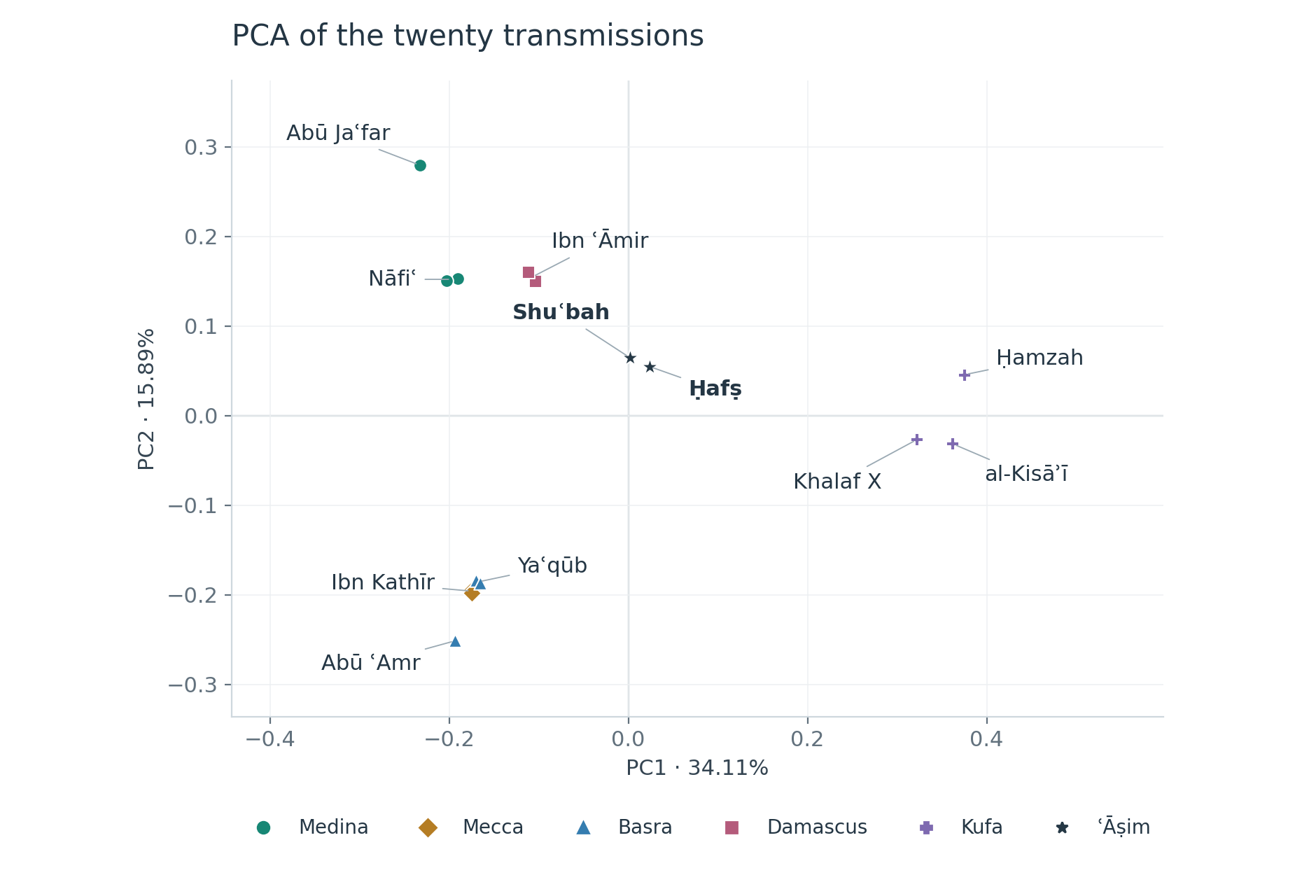
Figure 1. PCA axes 1 and 2 account for 34.11% and 15.89% of weighted variance, respectively: 50.00% combined. Reader labels identify pairs of transmission points; Ḥafṣ and Shuʿbah are labelled individually. Khalaf X denotes the tenth reader, represented by Isḥāq and Idrīs. Only labels are offset for clarity. Calculations and visualisation: GPT-6 Astra using Python.
The principal Kufan group—Ḥamzah, al-Kisāʾī and Khalaf al-ʿĀshir—lies on the right. The Medinan transmissions of Nāfiʿ and Abū Jaʿfar occupy the upper-left area, with the Damascene Ibn ʿĀmir nearby. Ibn Kathīr’s Meccan transmissions and the Basran transmissions of Abū ʿAmr and Yaʿqūb occupy the lower-left area.
Ḥafṣ and Shuʿbah lie close to one another in this two-axis view, in an intermediate position between the main regional groups.
Comparison with Sidky’s PCA
The broad arrangement partly resembles Sidky’s PCA in “Consonantal Dotting and the Oral Quran.” He identified a Kufan cluster of Ḥamzah, al-Kisāʾī and Khalaf; a Medinan cluster associated with Ibn ʿĀmir; and a Meccan–Basran group linking Ibn Kathīr and Abū ʿAmr. He treated ʿĀṣim and Yaʿqūb as distinct from these three groups. 2, pp. 792–793
| Relationship | Comparison with the present PCA |
|---|---|
| Main Kufan group | Ḥamzah, al-Kisāʾī and Khalaf again form a separate broad group. |
| Medina and Damascus | Medinan transmissions and Ibn ʿĀmir occupy a related area. |
| Mecca and Basra | Ibn Kathīr and Abū ʿAmr occupy the same broad side of the plot. |
| Yaʿqūb | Ruways and Rawḥ lie near the Meccan–Basran area in this projection; Sidky placed Yaʿqūb outside his three groups. |
| ʿĀṣim | Separate from the main Kufan group in both analyses; the present analysis distinguishes Ḥafṣ from Shuʿbah. |
Table 2. Comparison of the present PCA with Sidky’s published findings. Present calculations and comparison prepared with GPT-6 Astra; published results: 2.
This compares broad patterns across different datasets. Sidky analysed 292 words with consonantal-dotting variation at the level of ten readers, encoding permitted variants as indicator variables. The present PCA separates twenty transmissions and uses a broader fixed-feature inventory with equal block weights. The shared regional pattern is informative, while the different placement of Yaʿqūb shows that the analyses are not interchangeable. 2, pp. 791, 813
4. Diffusion mapping
The diffusion analysis compares permitted forms using Jaccard difference. Identical sets score 0, sets with no shared form score 1, and partial overlap falls between them. For example, {short, long} differs from {short} by 0.5. These scores compare permitted options, not their frequency of recitation.
Scores are averaged within each block and then across all 625 blocks, giving every block equal influence. The resulting pairwise differences are converted into connection strengths: smaller differences produce stronger connections. The scale controlling this conversion is approximately 0.377, the median positive difference between transmissions.
The connections are adjusted for uneven crowding (α = 1) and normalised to sum to one for each transmission. The map represents the patterns of these one-step connections (t = 1). Similar connection patterns place transmissions close together in the full representation; a few displayed axes give a partial view. “Diffusion” here describes mathematical relationships among readings, not reconstructed historical routes. 3
Diffusion axes 1 and 2
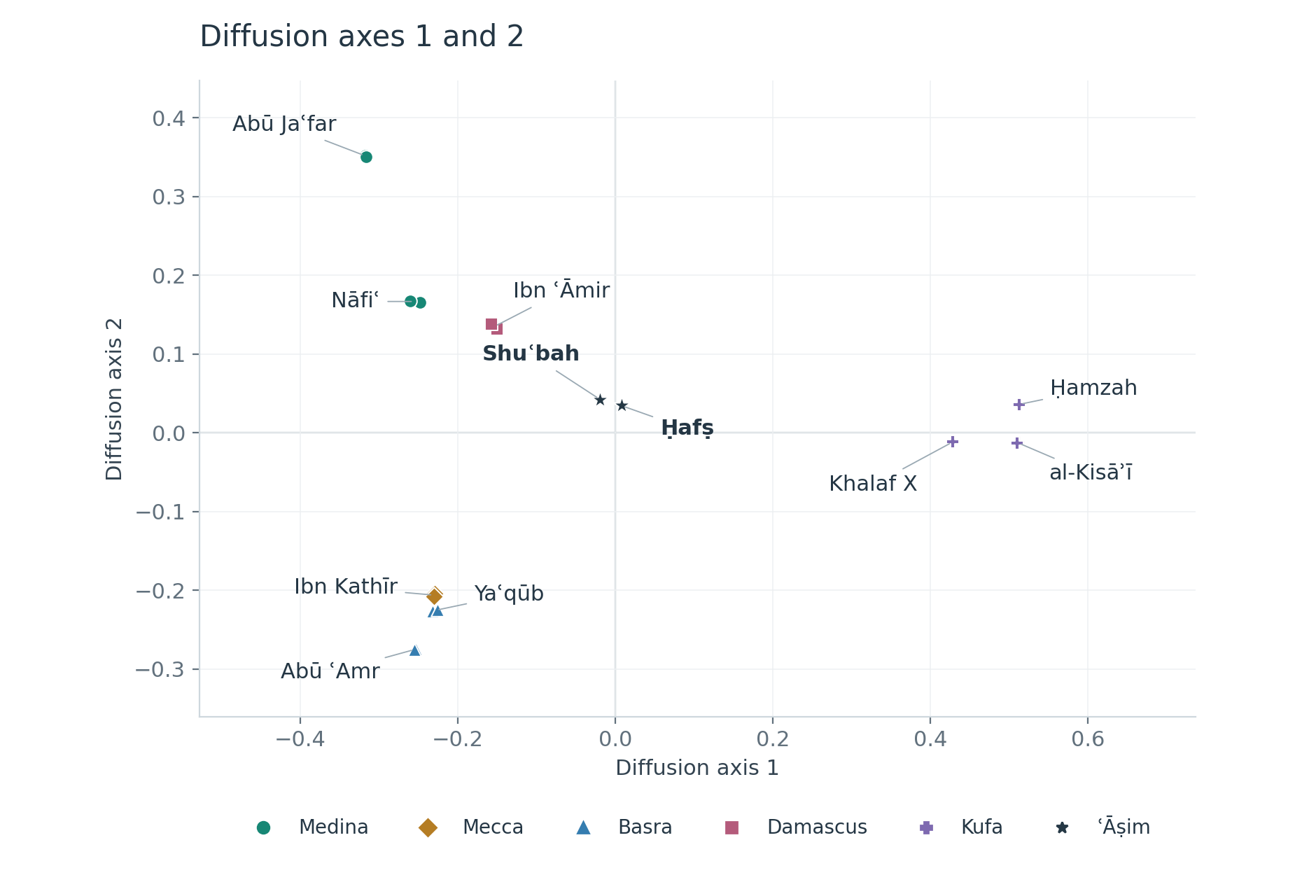
Figure 2. Diffusion axes 1 and 2 account for 67.09% of spectral energy, calculated from squared nonconstant eigenvalues. Spectral energy differs from the variance explained by PCA. All twenty transmissions are fitted together, retaining permitted sets and equal block weights. Calculations and visualisation: GPT-6 Astra using Python.
The regional arrangement remains visible: the principal Kufan group lies to the right, the Medinan and Damascene transmissions occupy the upper-left area, and the Meccan and Basran transmissions lie in the lower-left area. Ḥafṣ and Shuʿbah fall between these groups, despite their traditional Kufan affiliation.
Diffusion axes 1 and 3
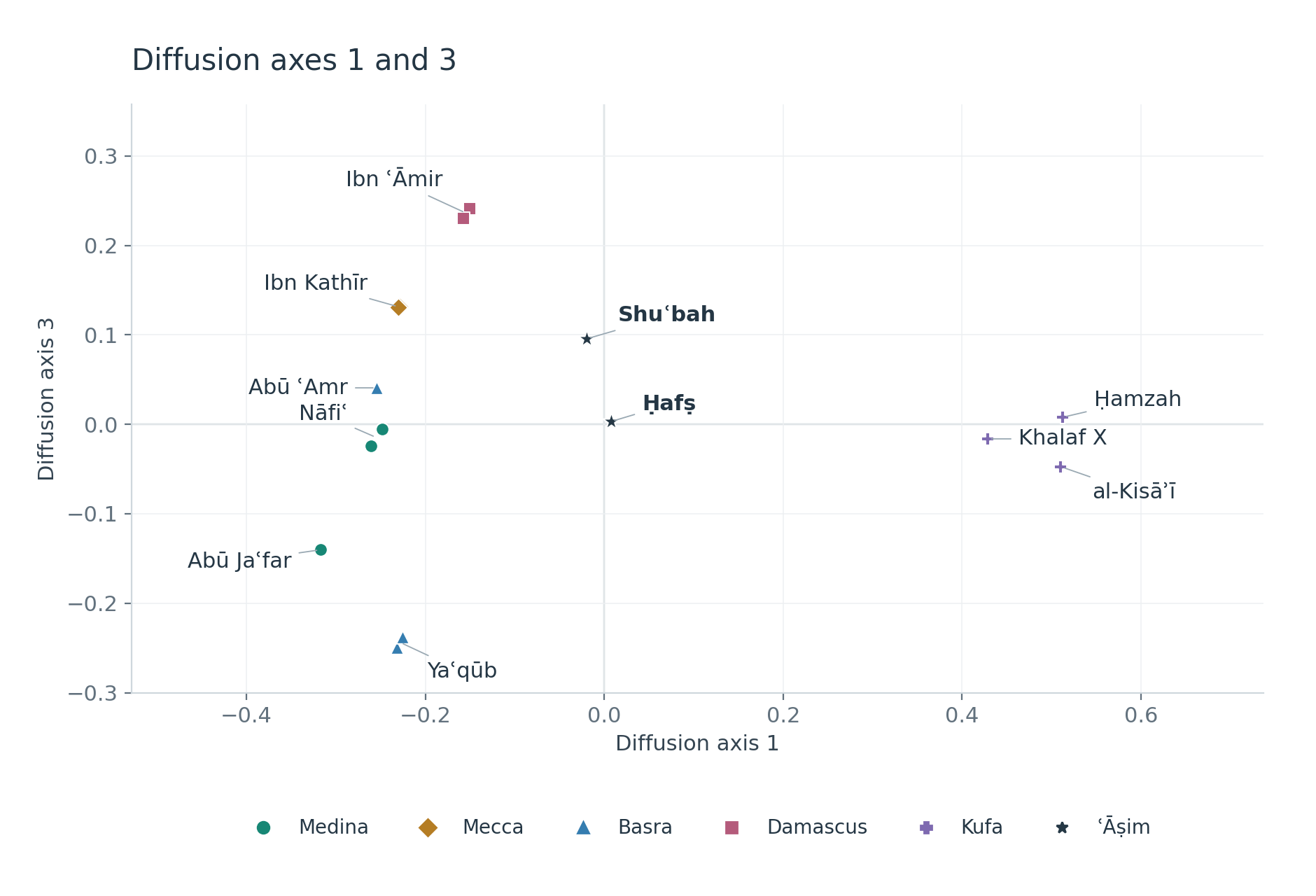
Figure 3. Diffusion axes 1 and 3 account for 58.48% of spectral energy. The coordinates come from the same fit as Figure 2; only the displayed axes change. Calculations and visualisation: GPT-6 Astra using Python.
The third axis separates transmissions that were close in the first two axes, particularly Ibn Kathīr and Yaʿqūb. It also distinguishes Shuʿbah from Ḥafṣ: their third coordinates are 0.095621 and 0.003084, respectively. Across the first three axes, Ḥafṣ lies closer to the coordinate origin, at 0.035495 diffusion units compared with 0.106383 for Shuʿbah.
Three-dimensional regional view
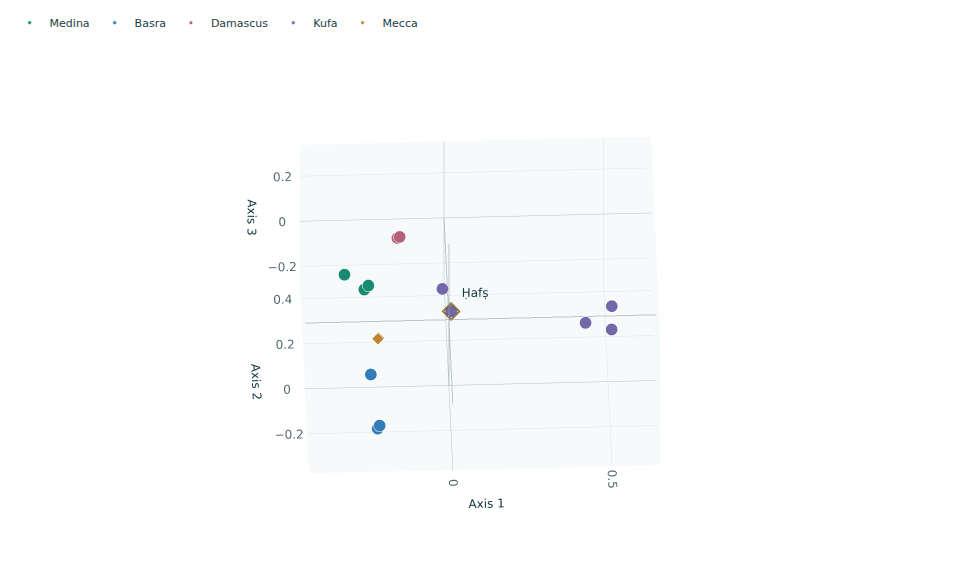
Figure 4. Frontal, orthographic view of diffusion coordinates 1–3. Ḥafṣ is highlighted; faint axes intersect at (0, 0, 0). The viewing angle changes the projection, not the coordinates. Calculations and visualisation: GPT-6 Astra using Python.
In this orientation, the arrangement broadly resembles regional geography: the principal Kufan group lies to the right, Damascus appears above Medina, and Mecca lies below it. The Basran transmissions appear farther down, visually suggesting southern Arabia, including Yemen, while Ḥafṣ and Shuʿbah remain between the surrounding groups. This resemblance depends on the chosen viewing angle and is not a measured fit to geographical coordinates.
Basra’s Yemeni and Hijazi connections
Historical teaching and social networks provide a firmer basis for interpreting Basra’s position than the visual resemblance alone. Several connections support the possibility of Yemeni influence alongside a clear Hijazi contribution:
Yemeni communities were present in Basra. Al-Samʿānī identifies Jarm as a Yemeni tribe, and al-Bukhārī records that ʿAmr ibn Salima al-Jarmī settled in Basra. These accounts place a member of this community within the Basran setting. 4 5
Jarm and the Ashʿarīs had established social ties. Zahdam describes “friendship and brotherhood” between them: «كان بين هذا الحي من جرم وبين الأشعريين ود وإخاء». Such ties offer a social setting in which teaching and recitation could circulate. 6
Abū Mūsā links the Basran traditions to an Ashʿarī teacher. Al-Dhahabī records his teaching of the Qurʾān in Basra. Ibn al-Jazarī includes him in the traditional chains behind both Abū ʿAmr and Yaʿqūb. 7 8
Abū ʿAmr had direct connections with Yemen. Al-Rāzī reports that Abū Khulayd studied some Qurʾān with him during his visit to Ṣanʿāʾ. His teacher ʿAṭāʾ ibn Abī Rabāḥ was born in al-Janad, Yemen, and raised in Mecca, linking Yemeni origins with a Hijazi teaching environment. 9 7 8
Yaʿqūb was affiliated with the Ḥaḍramīs. Al-Dhahabī calls him «الحضرمي مولاهم البصري», identifying him as their client in Basra. This supports a social affiliation, without establishing Yemeni ancestry. 7
Abū ʿAmr explicitly associated his reading with Hijazi teachers. Ibn Mujāhid reports his statement that he took his readings from the people of the Hijaz. Ibn al-Jazarī names Ibn Kathīr, Mujāhid and ʿAṭāʾ among his teachers. These links help explain his proximity to the Meccan reading in the plots. 10 8
Together, these reports suggest a Basran tradition connected to both Yemen and the Hijaz. Abū ʿAmr’s and Yaʿqūb’s southern Arabian connections and affiliations may have encouraged southern Arabian communities in Basra to adopt and preserve their readings. This offers a possible social explanation for their reception, alongside the documented Hijazi teaching links.
Interactive three-dimensional map
The interactive map uses the same coordinates and opens at the view shown in Figure 4. Calculations and interactive visualisation were prepared with GPT-6 Astra.
5. Full diffusion distances
The three-dimensional plot displays three of the model’s 18 nonzero dimensions, accounting for 74.80% of spectral energy. The remaining 25.20% lies in dimensions that are not shown.
GPT-6 Astra’s Python calculations use all 18 nonzero dimensions to obtain the full pairwise distances. These were checked against an equivalent calculation based directly on network connection patterns. Full distances capture differences hidden by the plotted projections.
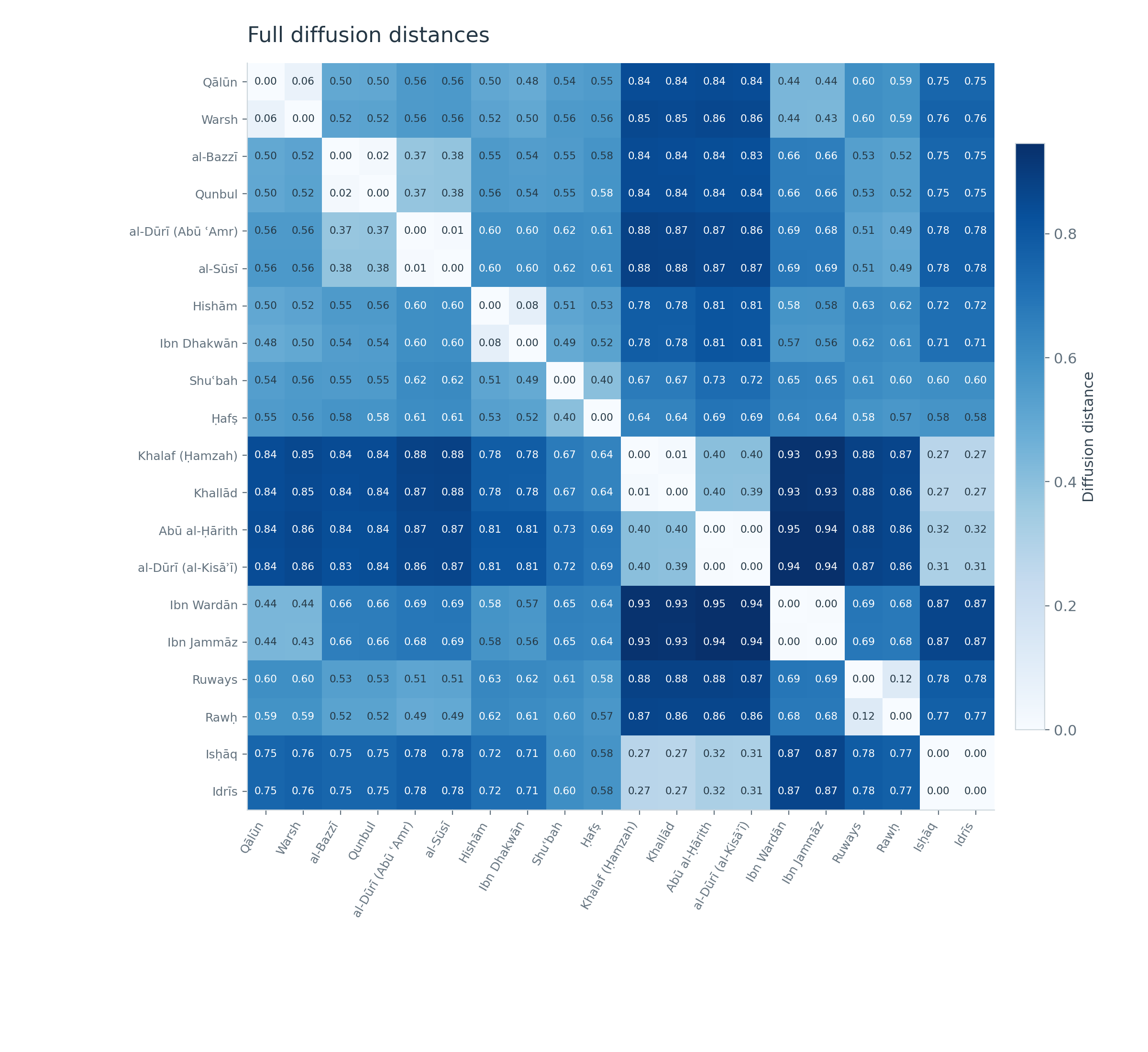
Figure 5. Full diffusion-distance matrix across all 18 nonzero dimensions. Values are rounded to two decimals, so a small nonzero distance may display as 0.00; the calculation files retain full precision. Calculations and visualisation: GPT-6 Astra using Python.
Several sister transmissions have very small distances, while regional groups are farther apart. Ḥafṣ also has a relatively even set of distances to the other transmissions. The following statistic measures that uniformity.
Uniformity of distances
Using Python, GPT-6 Astra calculated the population standard deviation of each transmission’s full distances to the other eighteen, excluding itself and its sister transmission—the other transmitter of the same canonical reader. The same rule applies to every row. Lower spread means more uniform distances. Mean distance is reported separately because uniformity alone does not imply proximity.
Ḥafṣ has the smallest spread, 0.049003, and the lowest mean distance, 0.598965, in this comparison. Its coefficient of variation is 8.18%, and its distances to the eighteen non-sister transmissions range from 0.518419 to 0.694554. It is therefore both the most evenly distanced and, on average, the closest transmission to the others under this measure.
| Rank | Transmission | Mean distance | Spread excluding sister | Spread including sister | Rank including sister |
|---|---|---|---|---|---|
| 1 | Ḥafṣ | 0.598965 | 0.049003 | 0.064799 | 1 |
| 2 | Shuʿbah | 0.606611 | 0.065837 | 0.078632 | 2 |
| 3 | Hishām | 0.633041 | 0.104625 | 0.159324 | 3 |
| 4 | Ibn Dhakwān | 0.624389 | 0.110584 | 0.161646 | 4 |
| 5 | Ruways | 0.677019 | 0.131148 | 0.178446 | 6 |
| 6 | Rawḥ | 0.662895 | 0.132603 | 0.177285 | 5 |
| 7 | Qālūn | 0.616774 | 0.144887 | 0.187667 | 7 |
| 8 | Warsh | 0.626646 | 0.147546 | 0.191067 | 8 |
| 9 | al-Bazzī | 0.622610 | 0.150259 | 0.199347 | 9 |
| 10 | Qunbul | 0.624630 | 0.150419 | 0.199768 | 10 |
| 11 | al-Sūsī | 0.651900 | 0.158271 | 0.210526 | 12 |
| 12 | al-Dūrī (Abū ʿAmr) | 0.648862 | 0.158772 | 0.210422 | 11 |
| 13 | Ibn Wardān | 0.714800 | 0.159934 | 0.222205 | 14 |
| 14 | Ibn Jammāz | 0.712991 | 0.160129 | 0.222050 | 13 |
| 15 | Isḥāq | 0.646145 | 0.200659 | 0.242821 | 15 |
| 15 | Idrīs | 0.646145 | 0.200659 | 0.242821 | 15 |
| 17 | Abū al-Ḥārith | 0.733492 | 0.210322 | 0.261572 | 18 |
| 18 | al-Dūrī (al-Kisāʾī) | 0.731915 | 0.210574 | 0.261545 | 17 |
| 19 | Khalaf (Ḥamzah) | 0.720903 | 0.219290 | 0.265748 | 19 |
| 20 | Khallād | 0.718615 | 0.220488 | 0.266382 | 20 |
Table 3. Ranking by population standard deviation of full diffusion distances. Self-distance is always excluded. The mean and primary spread exclude the sister transmission; the final two columns include it. Isḥāq and Idrīs tie because their coded profiles coincide. Calculations and tabulation: GPT-6 Astra using Python.
Including sister transmissions preserves the leading result: Ḥafṣ ranks first with spread 0.064799, followed by Shuʿbah at 0.078632. The full distance between Ḥafṣ and Shuʿbah is 0.402533, the largest within-reader pair distance in this dataset; the next largest is 0.118596 between Ruways and Rawḥ. Their proximity in the first two plotted axes therefore conceals substantial separation in the remaining dimensions.
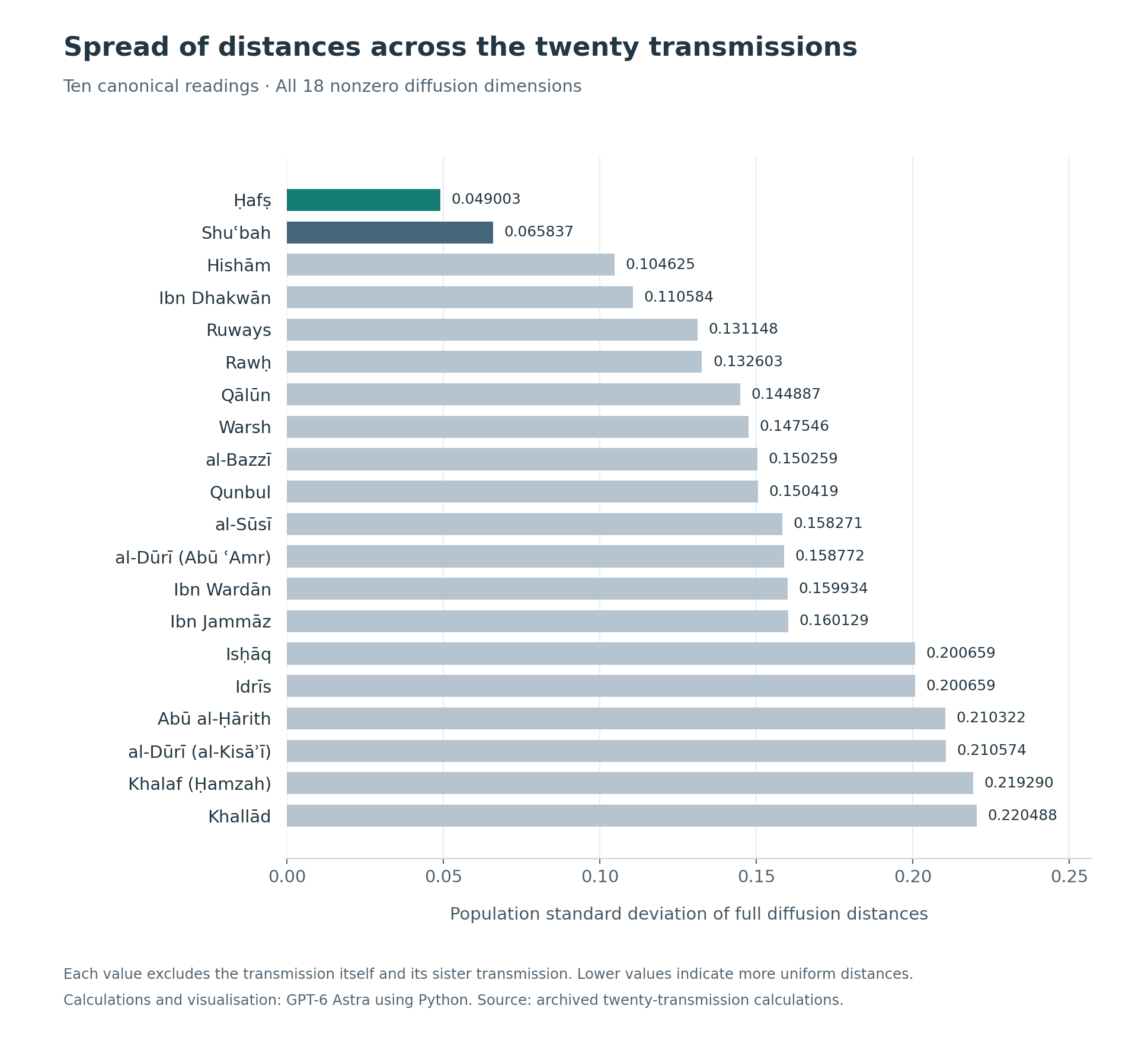
Figure 6. Spread of full diffusion distances in the twenty-transmission fit, excluding self and sister transmission. Lower values indicate more uniform distances to the other eighteen transmissions. Calculations and visualisation: GPT-6 Astra using Python.
6. Regional transmission and the position of ʿĀṣim
The regional clustering suggests that local teaching networks helped shape and reinforce differences between readings. Earlier authorities such as Ubayy ibn Kaʿb, Zayd ibn Thābit, Ibn Masʿūd and Abū Mūsā need not have possessed the exact regional profiles visible in the later canonical transmissions. Those profiles may reflect generations of teaching within particular communities. Regional influence could also continue through the teachers and routes following the canonical transmitters, preserving recognisable local characteristics.
Against this regional pattern, ʿĀṣim’s position, especially that of Ḥafṣ, requires explanation. Both Ḥafṣ and Shuʿbah stand apart from the principal Kufan group in PCA and diffusion mapping. Ḥafṣ lies near the origin in the first three diffusion coordinates and has both the lowest mean distance and the smallest spread of full distances to the non-sister transmissions. This combination indicates a comparatively close and balanced relationship with the wider set.
If local transmission reinforced regional characteristics, why did Ḥafṣ not align more closely with the other Kufan readings? The question concerns the entire transmission network, including the generations after Ḥafṣ. Predominantly local transmission would give reason to expect stronger Kufan alignment. Yet his coded profile lies between the main regional groups rather than clearly joining one of them.
One explanation is that this tradition maintained broader connections across teaching communities. Repeated contact could preserve widely shared features and limit exclusive alignment with a single region. On this interpretation, the reading later transmitted under Ḥafṣ’s name retained the character of a more widely shared recitation. This raises a historical question: what recurring institution could sustain that contact across generations?
7. Hajj and the preservation of a shared reading
Hajj offers a mechanism for such contact. Pilgrims from geographically separated communities gathered at a common religious centre, prayed together, encountered teachers and returned home. Repeated across generations, these journeys could connect regional traditions and help preserve features shared among them.
The Qurʾān describes this gathering as movement from distant regions toward a shared centre:
﴿وَأَذِّنْ فِي النَّاسِ بِالْحَجِّ يَأْتُوكَ رِجَالًا وَعَلَىٰ كُلِّ ضَامِرٍ يَأْتِينَ مِنْ كُلِّ فَجٍّ عَمِيقٍ﴾
﴿لِيَشْهَدُوا مَنَافِعَ لَهُمْ وَيَذْكُرُوا اسْمَ اللَّهِ﴾
—Qurʾān 22:27–28
The passage brings together distant communities, shared benefits and remembrance of God. The sanctuary thus offered a recurring meeting place beyond predominantly local religious networks.
Prayer makes the connection with recitation especially relevant. Qurʾān 2:125 describes the House as ﴿مَثَابَةً لِلنَّاسِ وَأَمْنًا﴾, a place of return and security, and commands ﴿وَاتَّخِذُوا مِنْ مَقَامِ إِبْرَاهِيمَ مُصَلًّى﴾. Abraham’s prayer in 14:37 likewise connects settlement beside the Sacred House with worship: ﴿رَبَّنَا لِيُقِيمُوا الصَّلَاةَ﴾. These passages connect repeated visitation with communal prayer.
Within the Hajj instructions, 2:198 commands ﴿فَاذْكُرُوا اللَّهَ عِنْدَ الْمَشْعَرِ الْحَرَامِ وَاذْكُرُوهُ كَمَا هَدَاكُمْ﴾. Remembrance continues after the rites in 2:200 and during the numbered days in 2:203. The words “as He guided you” prompt the question pursued here: through which recitation had those worshippers been guided, and how was it preserved in their shared remembrance?
The hypothesis advanced here is that the reading preserved in Ḥafṣ ʿan ʿĀṣim remained comparatively central because recurring contact at Hajj sustained it across regions. On this view, it was the majority recitation among pilgrims, alongside distinct minority readings. Because Hajj gathered Muslims from multiple regions, one could argue that recitational practice there offered a broader picture of Muslim usage than any single regional tradition. If the pilgrims broadly represented the wider Muslim population, a predominant recitation among them could therefore reflect majority usage across regions. Repeated contact and shared worship could have reinforced this common recitation and limited its regional divergence.
Evidence of recitational exchange through Hajj
Recitational consultation through Hajj is directly attested in the account of Abū ʿAmr, whose Hijazi teaching connections were noted above.
Ibn Mujāhid records that Abū ʿAmr’s brother, Abū Sufyān, said: 10, p. 84
«كان أبو عمرو إذا لم يحج أمرني فسألت عكرمة بن خالد المخزومي عن الحروف»
When Abū ʿAmr did not undertake Hajj, he instructed his brother to ask ʿIkrimah ibn Khālid al-Makhzūmī about particular readings. The report shows that pilgrimage could connect readers through intermediaries as well as personal travel. It supports the proposed mechanism of exchange, while leaving the identity and prevalence of any shared Hajj recitation to be established.
8. Ghadīr Khumm and Qurʾānic authority
If recurring contact at Hajj preserved a shared reading, that reading must have circulated before it became known as Ḥafṣ ʿan ʿĀṣim. The question is why this transmission would preserve the comparatively central form identified in the analysis, and what earlier authority could have encouraged communities across regions to maintain it.
The comparison begins with the recorded Companion associations of the seven readings selected by Ibn Mujāhid, distinguishing Ḥafṣ and Shuʿbah within ʿĀṣim’s tradition. 10
| Reader or transmission | Selected recorded Companion associations |
|---|---|
| Ḥafṣ → ʿĀṣim | ʿAlī ibn Abī Ṭālib, through al-Sulamī, in the specific attribution report. 7 |
| Shuʿbah → ʿĀṣim | Ibn Masʿūd, through Zirr ibn Ḥubaysh, in the same report. 7 |
| Nāfiʿ | Ubayy ibn Kaʿb and Zayd ibn Thābit; ʿUmar also appears in the recorded lines. 8 |
| Ibn Kathīr | Ubayy, ʿUmar and Zayd, through lines including ʿAbd Allāh ibn al-Sāʾib and Ibn ʿAbbās. 8 |
| Abū ʿAmr | Ubayy, Zayd and Abū Mūsā, among others; the recorded chains also reach ʿAlī and ʿUthmān. 8 |
| Ibn ʿĀmir | ʿUthmān, through al-Mughīrah ibn Abī Shihāb, and Abū al-Dardāʾ. 8 |
| Ḥamzah | Ibn Masʿūd and ʿAlī, through several recorded teaching lines. 8 |
| Al-Kisāʾī | Ibn Masʿūd and ʿAlī, through Ḥamzah and other teachers; additional connections are recorded. 8 |
Table 4. Selected Companion associations in the traditional transmission literature. The first two rows summarise a specific report about what ʿĀṣim taught; the other rows summarise broader, overlapping teaching chains.
Al-Dhahabī preserves the report distinguishing what ʿĀṣim taught his two transmitters: Ḥafṣ’s reading is traced through al-Sulamī to ʿAlī, while Shuʿbah’s is traced through Zirr to Ibn Masʿūd. The significance for this argument is the explicit attribution of the reading taught to Ḥafṣ, considered alongside its comparatively central numerical position. 7
The other readings in Table 4 are associated either with principal Companion authorities such as ʿUthmān, Zayd and Ubayy, or with several Companion lines. Ḥamzah and al-Kisāʾī, for example, are linked to both ʿAlī and Ibn Masʿūd. By contrast, ʿĀṣim’s reported account attributes the reading he taught Ḥafṣ specifically to al-Sulamī’s reading from ʿAlī. What is the significance of Ḥafṣ receiving a reading attributed exclusively to ʿAlī, and what gives that reading the authority to be relied upon by the wider muslim community? Hadith al-Thaqalayn offers a possible explanation.
Hadith al-Thaqalayn
Al-Nasāʾī and al-Ṭaḥāwī place the address at Ghadīr Khumm on the return from the Farewell Pilgrimage. Their report joins the Qurʾān with the Prophet’s household and states that the two will not separate before reaching the ḥawḍ. Al-Ḥākim records a parallel account, while related wording appears in al-Tirmidhī 3788 and Aḥmad 21654. 12 13
Al-Nasāʾī’s wording reads: 13
إني قد تركت فيكم الثقلين … كتاب الله، وعترتي أهل بيتي … فإنهما لن يتفرقا حتى يردا علي الحوض
“I have left among you the two weighty things … the Book of God and my ʿitrah, the people of my household … They will not separate until they come to me at the ḥawḍ.”
Household membership and proximity
The expression أهل بيتي, “the people of my household,” directs attention to close association and belonging. Al-Rāghib describes the original sense of a person’s ahl as those who share a dwelling with him, and also records uses based on a shared religion, occupation or place. This provides a linguistic basis for examining the company and shared life denoted by the expression. 14
The account of Noah brings the contrast between belonging and separation into focus. His son is described as في معزل, “standing apart”:
وَنَادَىٰ نُوحٌ ابْنَهُ وَكَانَ فِي مَعْزِلٍ
“Noah called to his son, who was apart.” — Qurʾān 11:42
Noah later appeals:
رَبِّ إِنَّ ابْنِي مِنْ أَهْلِي
“My Lord, my son is among my ahl.” — Qurʾān 11:45
God answers:
يَا نُوحُ إِنَّهُ لَيْسَ مِنْ أَهْلِكَ
“O Noah, he is not among your ahl.” — Qurʾān 11:46
On the reading developed here, في معزل introduces a separation that culminates in ليس من أهلك, “he is not of your ahl.” He refuses Noah’s invitation to join him, and the following explanation concerns his unrighteous conduct: the separation is from Noah’s believing community. Qurʾān 11:42–46
The same idea of association appears in expressions such as أهل الكتاب (people of Scripture), أهل العلم (people of learning) and أهل الصبر (people characterised by patience). Each identifies people through what unites or characterises them. In أهل بيتي, the association is specifically with the Prophet’s household not necessarily through blood kinship or marriage, but through actual closeness to his home (بيتي).
Hadith al-Kisāʾ explicitly includes Ḥasan, Ḥusayn, Fāṭimah and ʿAlī in the Prophet’s household. Muslim records their gathering beneath his cloak and his recitation of the purification passage. In al-Tirmidhī’s related account, he says: 11 12
اللَّهُمَّ هَؤُلَاءِ أَهْلُ بَيْتِي
“O God, these are the people of my household.”
Such proximity matters for the transmission of Qurʾānic knowledge. Qurʾān 73:2–4 describes prolonged night worship and measured Qurʾānic recitation, while 73:20 addresses the Prophet:
إِنَّ رَبَّكَ يَعْلَمُ أَنَّكَ تَقُومُ أَدْنَىٰ مِنْ ثُلُثَيِ اللَّيْلِ وَنِصْفَهُ وَثُلُثَهُ وَطَائِفَةٌ مِنَ الَّذِينَ مَعَكَ
“Your Lord knows that you stand for somewhat less than two-thirds of the night, and half of it, and a third of it, together with a group of those who are with you.” — Qurʾān 73:20
Those who shared the Prophet’s household life would have had repeated opportunities to hear his recitation during long periods of night worship. This sustained proximity offers a plausible basis for their familiarity with his Qurʾānic recitation and teaching.
The words فإنهما لن يتفرقا, “the two will not separate,” are understood here as affirming agreement between the Qurʾān and the household’s recitation and teaching. Read alongside Hadith al-Kisāʾ, this gives particular significance to ʿAlī’s Qurʾānic authority and provides the proposed basis for recognising his reading across regional communities.
On this interpretation, the declaration supplied an authoritative point of reference when disagreements arose over the Qurʾān. Recognition of ʿAlī’s position could therefore have encouraged communities beyond his immediate surroundings to seek, transmit and preserve his recitation.
Taken together, these strands support the hypothesis that Ḥafṣ ʿan ʿĀṣim preserves an early, widely shared form of the Prophet’s recitation. Its comparatively central profile and low distance spread provide the numerical pattern; Hajj supplies a recurring setting for communal preservation; and Hadith al-Thaqalayn offers an explanation for the wider recognition of ʿAlī’s authority. The reported line Ḥafṣ → ʿĀṣim → al-Sulamī → ʿAlī connects that authority to the surviving transmission. On this hypothesis, its centrality reflects continuity with a common early recitation maintained across regional boundaries.
9. Implications for the seven aḥruf and early manuscripts
The seven aḥruf and the authority of variant readings
If this reconstruction is correct, it raises a further question: how did divergent readings acquire comparable religious authority?
Could the aḥruf reports have served to legitimise regional variants, including readings supported by individual transmission reports (akhbār āḥād)? A stronger claim—that the reports were fabricated for that purpose—would require independent evidence from their wording, transmission chains and earliest attestations.
Early manuscripts and the circumstances of their survival
Early manuscripts containing readings that differ from Ḥafṣ must also be considered. A securely identified variant establishes that a written form existed, but does not by itself establish how widely it was recited. Was a copy used throughout a community, within a particular mosque or teaching circle, or preserved after falling out of use?
Survivorship bias must therefore be considered: surviving copies cannot simply be counted as a representative sample of early recitation. Equally, storage or fragmentary survival does not establish that a reading was rejected. Each manuscript requires assessment of its date, provenance, script, corrections and evidence of use. Where that context is missing, both its former prevalence and the reason for its preservation remain uncertain.
References
[1] nQuran. Shāṭibiyyah/Durrah comparison inventory, archived snapshot dated 20 September 2026. The inventory records documented differences rather than twenty independently aligned complete Qurʾānic texts.
[2] Sidky, Hythem. “Consonantal Dotting and the Oral Quran.” Journal of the American Oriental Society 143, no. 4 (2023): 785–814, especially 791–794 and 813.
[3] Coifman, Ronald R., and Stéphane Lafon. “Diffusion Maps.” Applied and Computational Harmonic Analysis 21 (2006): 5–30. The settings used in this report are described in Section 4.
[4] Al-Samʿānī. Al-Ansāb, “al-Jarmī,” 2:47.
[5] Al-Bukhārī. Al-Tārīkh al-kabīr, entry 2497: ʿAmr ibn Salima al-Jarmī.
[6] Al-Bukhārī. Ṣaḥīḥ al-Bukhārī, hadith 7555, Zahdam’s report concerning Jarm and the Ashʿarīs.
[7] Al-Dhahabī. Siyar aʿlām al-nubalāʾ: Abū Mūsā al-Ashʿarī, on teaching in Basra; ʿAṭāʾ ibn Abī Rabāḥ, 5:78–79; Yaʿqūb, 10:169; and ʿĀṣim ibn Abī al-Najūd, 5:258–259, on the readings taught to Ḥafṣ and Shuʿbah.
[8] Ibn al-Jazarī. Al-Nashr fī al-qirāʾāt al-ʿashr, vol. 1, introductory discussion of the seven aḥruf and the seven readings, and sections on the teaching chains of Nāfiʿ, Ibn Kathīr, Abū ʿAmr, Ibn ʿĀmir, ʿĀṣim, Ḥamzah, al-Kisāʾī and Yaʿqūb.
[9] Al-Rāzī. Tārīkh madīnat Ṣanʿāʾ, p. 342, on Abū Khulayd’s study with Abū ʿAmr.
[10] Ibn Mujāhid. Kitāb al-Sabʿah fī al-qirāʾāt, p. 84, Abū ʿAmr’s Hijazi sources and the report of Abū Sufyān ibn al-ʿAlāʾ.
[11] Muslim. Ṣaḥīḥ Muslim, hadith 2424, the cloak report.
[12] Al-Tirmidhī. Al-Jāmiʿ: hadith 3788, the Qurʾān and the household remaining together until the ḥawḍ; and hadith 3787, the cloak report.
[13] Al-Nasāʾī, Al-Sunan al-kubrā, hadith 8092, and al-Ṭaḥāwī, Sharḥ mushkil al-āthār, hadith 1765: Arabic texts of the address at Khumm. See also al-Ḥākim, Al-Mustadrak, hadith 4576 in the linked edition. Related wording that the Qurʾān and the household will not separate appears in Aḥmad ibn Ḥanbal, Musnad, hadith 21654, and al-Tirmidhī 3788 [12]. For al-Ḥākim’s household reports, see hadiths 3558–3559. Hadith numbers follow the linked editions.
[14] Al-Rāghib al-Iṣfahānī. Al-Mufradāt fī gharīb al-Qurʾān, entry “ahl” (أهل), on shared dwelling and other forms of association.
Calculation record
Revision and audit — 6 October 2026. GPT-6 Astra audited the archived data and calculations, applied three block-grouping corrections and excluded one conditional feature, then reran the analyses and regenerated the figures and tables. Compared with the original results, Ḥafṣ’s mean full diffusion distance to the eighteen non-sister transmissions decreased by 1.16%, while its distance spread increased by 2.12%. The rankings of all twenty transmissions by these two measures were unchanged, with Ḥafṣ remaining first for both. This supports the numerical stability of the reported rankings under these corrections and the chosen weighting.
Calculations and numerical checks: GPT-6 Astra using Python. This revision uses the original archived dataset with four audited analysis corrections dated 6 October 2026: the connecting-vowel components at 4:66, 17:110 and 73:3 are assigned to the existing connecting-two-sukūns rule block, and the conditional hāʾ component at 36:35 is excluded because it does not safely represent transmissions omitting that hāʾ. Every other retained transmission-state assignment is unchanged. All tables, figures and attached scenarios were regenerated from this repaired dataset. Independently reconstructed input distances agree within 1.4 × 10⁻¹³; full diffusion distances agree with direct transition-profile distances within 2.5 × 10⁻¹⁵ across the six attached scenarios. The PCA squared-distance reconstruction error is below 6.3 × 10⁻¹⁴. The original source archive is preserved, and the calculation package records the exact changes, source hashes and reproduction code. These checks establish numerical consistency; they do not independently validate every source transcription or coding decision.
Revised diffusion atlas and comparison scenarios
Revised dataset, calculations and source code · Archived source inventory